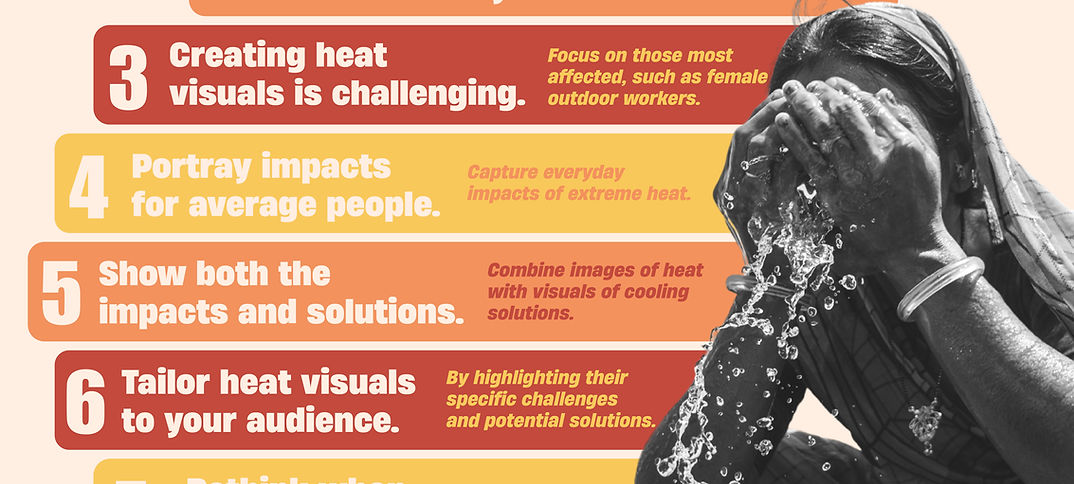
The accelerating effect of extreme heat is now the biggest killer among climate extreme events. But the scale and seriousness of the threat is hard to portray visually, not least because heat is largely invisible — unlike other climate extremes such as floods and storms — and because many of those suffering its impact do so indoors, out of the public eye.
1. Avoid Visuals That Downplay the Danger
Typical “fun in the sun” images — people at fountains, beaches, eating ice cream — undermine the urgency of extreme heat as a deadly threat. Avoid visuals that make heat look pleasant or merely inconvenient rather than dangerous.
2. Extreme Heat Is More Than a Weather Story
Heat stories should show how temperature affects every dimension of daily life: health, transport, jobs, food security, and family relationships. Think beyond thermometers and weather maps.
3. Focus on the Most-Affected
Outdoor workers — construction workers, delivery drivers, police officers, ambulance crews — are among the most exposed. Women in informal economies face compounding risks. Seek out the people experiencing the sharpest impacts.
4. Accurately Portray Impacts for Average People
Show families seeking shade without access to air conditioning or fans. Show medical workers treating heatstroke. Show outdoor workers sweating through long shifts. Real, grounded imagery communicates the stakes more effectively than dramatic abstractions.
5. Show Both the Impacts and Solutions
Combine images of heat’s human impacts with constructive solutions: shade structures, urban parks, reflective roofs. Audiences need to see both the problem and that responses are possible.
6. Think About Your Audience
Consider what heat-related problems your specific audience faces — difficult commutes, inadequately cooled workplaces, disrupted sleep. Connect the story to their direct experience.
7. Rethink When to Shoot
Don’t limit coverage to the hottest parts of the day. Include nights when people cannot sleep. Heat’s effects are round-the-clock and year-round.
8. Build Sources and Seek Access Ahead of Time
Getting access to hospitals, ambulances, or schools during a heat event requires advance planning and relationship-building. Start before the next heatwave hits.
9. Take Care of Yourself
Heat can be debilitating and deadly for photographers too. Take regular breaks, hydrate consistently, wear sun protection, and know the warning signs of heat illness.
10. Think About Your Equipment
Smartphones, cameras, and drones can overheat and malfunction in extreme temperatures. Keep equipment cool between shots, take breaks between takes, and plan for equipment failures in the field.