Counting the cost of heat: the case for urgent solutions for cities
HERA’s first-of-its-kind analysis of the costs and benefits of targeted action on the impacts of extreme heat.

Extreme heat is affecting cities around the world, and the costs are rising. From increased mortality and illness to lost labor productivity, higher healthcare expenditures, and damage to infrastructure, communities pay a high price not only when temperatures soar but long after. For instance, heat can cause economic losses worth as much as 8% of city GDP in extreme years.
Yet, despite the scale of the impacts, many cities struggle to identify, prioritize, and finance effective adaptation measures. Too often, decision-makers lack the tools and evidence needed to understand who is most vulnerable, assess the costs of inaction, and compare the benefits of different interventions.
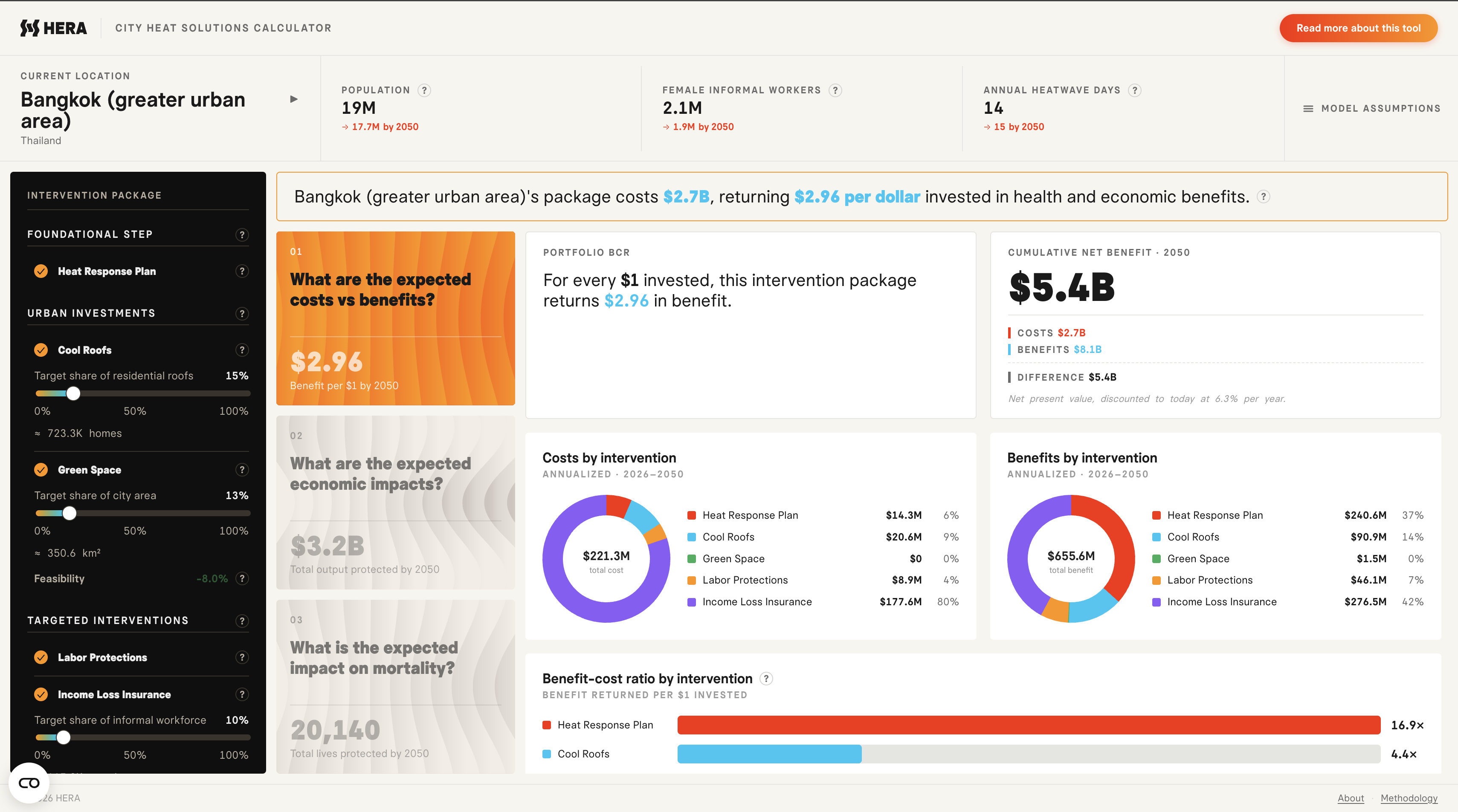
HERA’s first-of-its-kind tool and analysis help policymakers, practitioners, development partners, and other stakeholders understand the impacts of extreme heat and evaluate the case for adaptation.
Users can compare the costs and benefits of different adaptation measures to find those with the greatest returns, explore how heat affects mortality and economic output across 11,408 cities in 190 countries, and see how these impacts could evolve through 2050.
The tool provides both critical insights and practical frameworks for explaining how heat affects people and economies.

Through the tool and report, stakeholders can:
- Understand how extreme heat affects mortality and economic output in cities around the world, and explore how these impacts could evolve through 2050.
- Evaluate the costs and benefits of different adaptation measures to identify interventions that reduce risk, improve outcomes, and generate the greatest economic and social returns.
- Draw on the most comprehensive analysis to date of extreme heat’s impacts on women, integrating city-level climate projections, health and labor productivity modeling, gender-disaggregated economic analysis—including unpaid labor—and qualitative evidence from informal women workers.
- Explore city-specific case studies that illustrate the lived experiences of those most affected by heat, from how it disrupts their sleep to how it spoils the wares they sell.
By combining climate projections, health and economic modeling, gender-disaggregated analysis, and city-level evidence, the tool and report provide practical insights to support more informed and effective decision-making. Cities that invest in inclusive design protect their most exposed residents and see a return on every dollar spent. Through this analysis, stakeholders can identify effective solutions, strengthen investment decisions, and support a better future in a hotter world.
Watch women speak on the impacts of extreme heat and read the deep-dive reports from the cities
Watch the videos to hear informal women workers across the four cities speak about how extreme heat is hitting their income and health
Gitaben Rawal, Headloader
Gitaben carries heavy loads through extreme heat by day — then returns home to a tin-roofed house that traps it through the night. Her story reflects the reality for women in Ahmedabad’s informal economy, who lose an average of 7% of their annual wages to extreme heat.
Kanokporn Hoosawatdee, Food vendor
Kanokporn faces heat that threatens her health, cuts her sales, and drives up her electricity bills — in a city where every 1°C rise in temperature costs an estimated ฿17 billion (US$535 million) in additional electricity costs annually.
Isha Mansaray, Petty Trader
Isha runs her stall in an uncovered market where heat doesn’t just exhaust her — it drives away customers and spoils her goods. Across Freetown, women in the informal sector lose 8% of their wages to heat-related productivity losses.
Sarahi Martinez, Transport driver
Sarahi drives her route through stifling heat while managing diabetes and high blood pressure. Her experience reflects a city-wide crisis: without urgent action, heat-related deaths in Monterrey could rise nearly fivefold by 2050.